
THE UNIVERSITY OF SASKATCHEWAN’S MAIN CAMPUS IS SITUATED ON TREATY 6 TERRITORY AND THE HOMELAND OF THE MÉTIS.
THE UNIVERSITY OF SASKATCHEWAN’S MAIN CAMPUS IS SITUATED ON TREATY 6 TERRITORY AND THE HOMELAND OF THE MÉTIS.
HEATHER MORRISON
Arts Writer
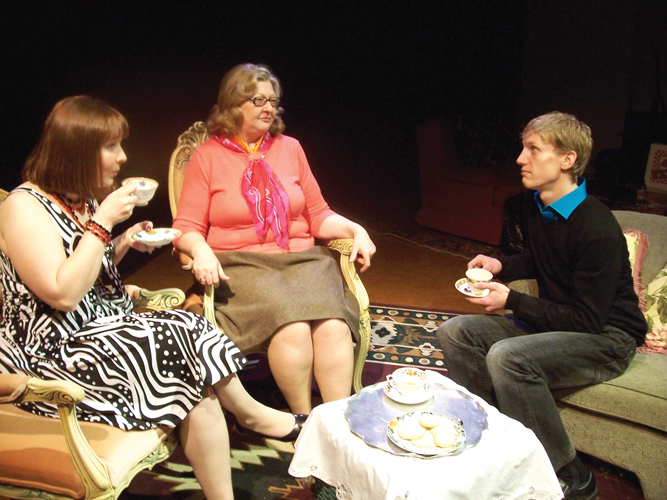
Seven years ago Angela Christie founded Theatre Ecstasis with co-conspirators Joshua Beaudry and Rob van Meenen, creating a personal playground for edgy, thought-provoking works — a place for the kind of material that an actor can wrestle with and feel satisfied over the struggle.
So when Christie picks up a script hoping to find a suitable show for her company’s slot in the Live Five series, she knows exactly what to look for: a challenge. And that is precisely what Christie, her fellow cast mates and director Pamela Haig-Bartley have discovered with Philip Ridley’s Leaves of Glass.
Set in London’s East End, the play is an examination of family secrets and their menacing repercussions.
“We’ve had some great discussions during rehearsals about the loss of a loved one, about secrets and how they affect a relationship, about suicide, drug abuse, child abuse, depression, a couple’s first child and about how fragile our memories are,” said Christie.
The fallibility of memory hangs like a black, dramatic cloud over the production.
“The memories of their past and how they choose to deal with them completely rule their lives,” said Christie.
The characters are haunted by incredibly potent images that have influenced their emotional and psychological development, but, as becomes obvious throughout the play, these memories may not be accurate
In an interview about Leaves of Glass, the playwright mentioned the Rashomon Effect: when personal viewpoint causes a distortion in the perception of events and consequently many different versions of the “truth” are created.
“Personally, I think if someone believes in something strong enough, it does become truth — to them,” explained Christie.
Ridley toys with this notion of multiple truths in the play. Each family member has a different perspective on the past and they fight for their version to be accepted as what ultimately happened. To them it is true because they believe in it — a form of household propaganda. The question then becomes one of whether or not contradictory accounts of the past can co-exist, and is left on stage like an open wound.
“There’s the kicker,” said Christie. “This is kind of a philosophical question I think: our perceptions alter our memories, therefore who can really say what the truth actually is? In the case of this play, I think audiences will all come to the same agreement on what actually happened because they’re given all sides of the story, but for the characters there definitely are multiple truths.”
“The characters are so complex,” said Christie. “It’s not an easy play to follow and it leaves some questions unanswered, but I hope it opens up discussion afterwards. I think plays like that are exciting and more engaging than being told what to think.”
Leave a Reply