
THE UNIVERSITY OF SASKATCHEWAN’S MAIN CAMPUS IS SITUATED ON TREATY 6 TERRITORY AND THE HOMELAND OF THE MÉTIS.
THE UNIVERSITY OF SASKATCHEWAN’S MAIN CAMPUS IS SITUATED ON TREATY 6 TERRITORY AND THE HOMELAND OF THE MÉTIS.
RORY MACLEAN
News Editor
The Supreme Court of Canada has recently introduced a new defence against libel that could have a profound effect on bloggers and journalists.
“It’s a really big deal,” said Mary Agnes Welch, president of the Canadian Association of Journalists.
“First of all, it’s important to know that Canada’s libel laws are quite a bit more conservative than they are in a lot of other countries.”
A new defence of “responsible communication on matters of public interest” can be used against charges of libel following a December supreme court ruling.
The strongest defence against libel is truth. The truth is never libelous, but proving some facts to be true in a court of law has been a challenge for many journalists.
“It used to be that you had to have an honest belief in the truth of the facts that you were basing your comment on,” said Reynold Robertson, a lawyer who handles defamation suits for The StarPhoenix.
“Previously most people couldn’t say they had an honest belief in the facts because they just accepted what they had been told,” he said.
Responsible communication reduces the constraints, so writers simply have to prove they have attempted to verify the truth of what was published.
“We can say that the story is substantially accurate,” said Welch. “We don’t have to say it’s completely accurate. As long as we’ve done what all good journalists should do, which is check our sources.
“You can go and say, ”˜Here’s everything I did to make sure the story was right and fair’”¦. This is a pretty radical departure from what it said before, which was basically that you had to prove everything you said.”
Welch feels requiring journalists to be able to prove the truth of everything they print has led to a chilling effect in Canada, where some stories don’t even get printed, despite being in the public interest.
Most journalists cannot afford to hire a lawyer to defend against a charge of libel, especially freelancers and bloggers, who are increasingly becoming a source of citizen journalism.
Before being caught on charges of fraud and obstruction of justice, Conrad Black was infamously litigious, threatening legal action against journalists who attempted to publish his exploits.
“Conrad Black was famous for that,” said Roberston. “People were being intimidated against expressing their views because they were afraid to get sued.”
The new responsible communication defence could help reduce the chilling effect and allow more stories of pressing public interest to be published, said Welch.
“All papers have lawyers”¦ and on all the awesome juicy stories we get them lawyered, right? And when it comes back, it’s often all the juicy parts that get red-penned right out of there.”
Having an additional defence may prevent lawyers from editing out these juicy tidbits, said Wesch.
Despite the new defence, libel suits will always be a threat for newspapers.
“Probably every newspaper gets sued from time to time,” said Steve Gibb, editor of The StarPhoenix. “We’ve had our fair share of lawsuits, or at least threats. Most of them tend to go away, and don’t go beyond idle saber rattling. You certainly have to take them very seriously.”
Gibb doesn’t think the new defence will cause a “field day” for investigative journalism.
“Sometimes seemingly very innocent-type stories can get you problems just as much,” he said. “It’s sometimes easier for something to slip through if it’s a less complicated story.”
Responsible communication may not reduce the threat of legal action, but it does enshrines ethical reporting practices by asking journalists to account for their reporting process.
The effect of this new defence has potential applications for bloggers, but it has yet to be felt in this realm.
“Not many bloggers have been sued for libel,” said Welch. “Everybody’s kind of waiting for the one big case.”
Blogs may have had a profound effect on public discourse, but they are still a long way from doing well-sourced journalism, said Welch.
– –
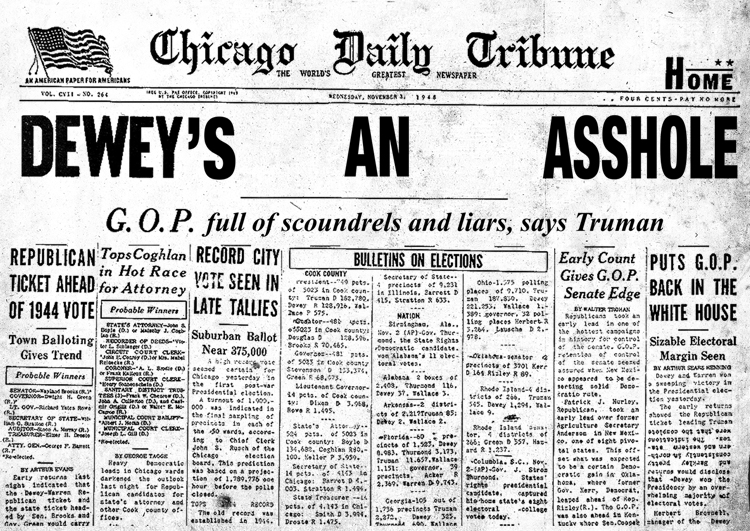
image: Matthew Stefanson (please don’t sue us, Chicago Daily Tribune)

Leave a Reply