
THE UNIVERSITY OF SASKATCHEWAN’S MAIN CAMPUS IS SITUATED ON TREATY 6 TERRITORY AND THE HOMELAND OF THE MÉTIS.
THE UNIVERSITY OF SASKATCHEWAN’S MAIN CAMPUS IS SITUATED ON TREATY 6 TERRITORY AND THE HOMELAND OF THE MÉTIS.
ALEXANDRIA ELRIDGE
CUP Alberta and Northern Bureau Chief
EDMONTON (CUP) – Canadian researchers have identified the youngest neutron star ever discovered out of the remnants of a supernova.
The finding will give insight into the structure of stellar explosions and the development of neutron stars from a young stage.
When a heavy star explodes — a phenomenon called a supernova — either a black hole is produced or the star’s core can collapse into a tiny remnant called a neutron star.
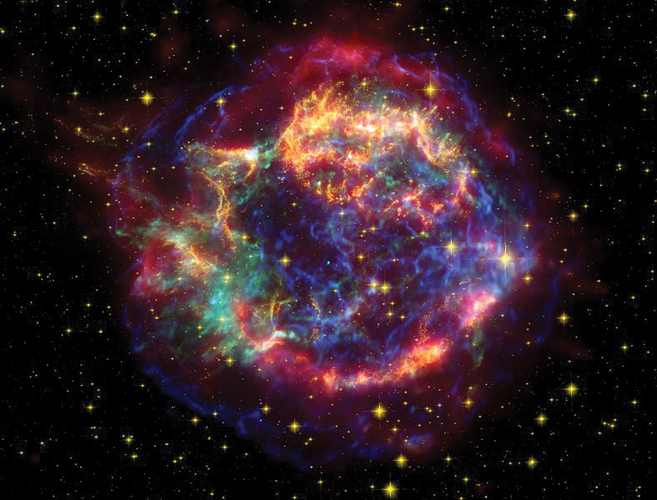
When the Cassiopeia A supernova occurred about 300 years ago, it left behind what appeared to be a neutron star, though the remnant was only first viewed in 1999 by a powerful X-Ray telescope. While it was at first presumed to be a neutron star, astronomers found that it did not display characteristics typical of that type of remnant.
The strange properties, it turns out, are because of the neutron star’s young age.
Craig Heinke, a professor of physics at the University of Alberta, is one of the researchers behind the findings. He explained that neutron stars are mostly packed neutrons, with a matter-based atmosphere about 10 centimetres thick; this atmosphere modifies the amount of radiation that reaches Earth. In all other neutron stars astronomers have studied, this atmosphere has been composed of hydrogen.
“You expect to have hydrogen on top, and (other researchers) tried fitting it with a hydrogen atmosphere model, but (it) was not large enough to make it consistent with neutron star,” Heinke said.
Many researchers tried other explanations or considered the possibility that it was not a neutron star at all, but no other theories fit.
At this point, Heinke and his colleague Wynn Ho, a researcher from the Southampton University School of Mathematics in the U.K., decided to try and fit the neutron star to other atmospheric models.
“The carbon atmosphere was both a good fit, and it predicted the size of the neutron star to 20 or 22 kilometres, so suddenly everything fell into place. This could be a neutron star; it just has to have a surface layer of carbon,” Heinke said.
This led the researchers to consider why this neutron star would have a carbon-based atmosphere rather than the usual hydrogen atmosphere.
“We think that in the early few hundred years of the neutron star’s life, the surface of the neutron star is so hot that it’s actually able to (fuse) hydrogen and helium to carbon,” Heinke said.
The theory predicts that as the neutron star ages, it cools off and its atmosphere changes to hydrogen.
“Material is still gently raining down onto the neutron star; the neutron stars accumulate a layer of hydrogen that is no longer able to burn off,” Heinke explained.
Heinke said that this discovery is significant, because it gives them understanding into the development of a neutron star’s atmosphere, but it also helps explain the composition of the supernova that exploded and is still raining down matter on the neutron star.
“There has to be enough hydrogen in there to be able to rain down onto the neutron star and produce a hydrogen atmosphere over time, and we’d like a better understanding of what the interiors of supernovas are like — these being the things that produce all the elements that make up the universe,” Heinke said.
The physicist also said that the discovery could help researchers learn more about the interior of neutron stars by comparing them to other objects with carbon atmospheres.
“There’s what you call a ”˜quark soup,’ and that’s a hypothesized state of matter which has never been seen. It’s possible that that makes up part of the interior of neutron stars,” Heinke said.
Sonia Milbradt, president of the Undergraduate Physics Society at the University of Alberta, said that the discovery is just as exciting for students as it is for scientists.
“I think it’s really exciting because it adds to the prestige of our department,” she said. “It helps us to realize that there is important research going on in the department so it increases department pride.”
Heinke and Wynne’s findings were published in the journal Nature earlier this month.
– –
photo: Wikimedia Commons

Leave a Reply