
THE UNIVERSITY OF SASKATCHEWAN’S MAIN CAMPUS IS SITUATED ON TREATY 6 TERRITORY AND THE HOMELAND OF THE MÉTIS.
THE UNIVERSITY OF SASKATCHEWAN’S MAIN CAMPUS IS SITUATED ON TREATY 6 TERRITORY AND THE HOMELAND OF THE MÉTIS.
GREG REESE
Arts Editor
Trudging across the bowl, around the hideous chain link fences and bulldozers, we pulled our jackets tight around us. A crowd could be seen in the distance, coagulating beneath floodlights and temporarily installed statues in front of the arts building. Clouds of vapour issued forth from mouths and scarves (actually, one guy was smoking a pipe!). Around 100 onlookers stood waiting for something — but what?
Clearly, none of us were certain what the hell was going on. But luckily this heightened, rather than diminished, the general feeling of anticipation.
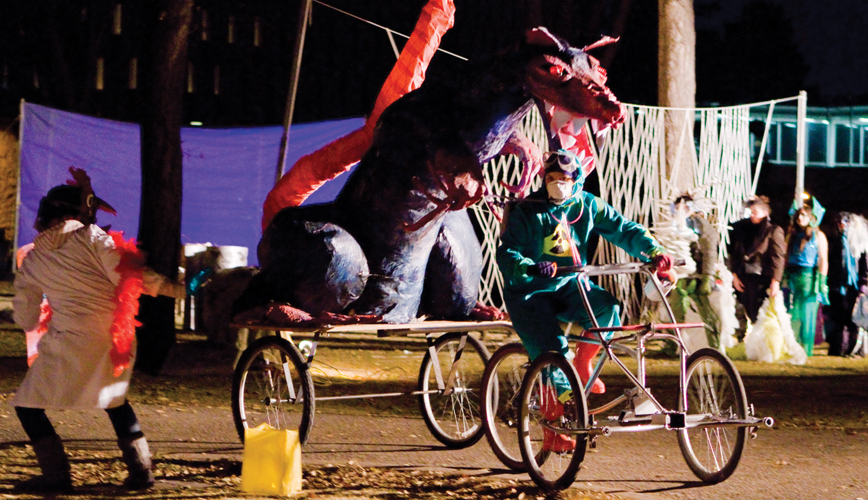
A co-worker and I had watched part of a rehearsal earlier in the day and were completely blown away — huge creatures with Easter Island-like faces chased fairies and sea creatures, weaving in and out of elaborate, mixed-media sets; music blared over massive speakers while mimes brewed strange mime concoctions. Still, we understood little of what we witnessed there. The whole thing vigorously eluded definition.
After returning in the evening to watch the actual performance, I must admit, a firm interpretation still evades me. So we’ll talk facts.
The aptly named Spectacle began as a cross-disciplinary course between the departments of drama and art and art history. In particular, movement and sculpture fill out the core building blocks of Spectacle.
Art professor Alison Norlen helped illuminate the rather mysterious aspects of Spectacle.
“A couple of years ago, I attended the Rio Carnival. I was doing some work there and I did another trip on a President’s SSHRC (Social Sciences and Humanities Reseach Council) related to the Day of the Dead. I developed it starting then,” said Norlen. “The university has been very helpful for this course.”
The art and drama students who enrolled in the course knew they would be working in a compressed period of time and also that a significant part of the course would be held at the Emma Lake campus.
“It was the same hours as a regular class but quite compact. We put a lot of hours in after class into the production of this event. We really got to know each other very well,” said Alexa Hainsworth, a sculpture student who rode a giant rat-bicycle in the Spectacle performance.
“The drama students had not really worked with their hands before, so it’s a little different for them too — to construct something visually from their heads. We’d give them some wire and they would wonder, ”˜what are we supposed to do with this?’ It was fun and different.”
We put a lot of hours in after class into the production of this event. We really got to know each other very well.”
-Alexa Hainsworth
The flip side was that art and art history students learned movement and puppetry from the drama side.
“The art students were shown mask making and then compositional aspects, object manipulation, puppetry, found objects and how you manipulate those and work with those in a compositional way,” said Natasha Martina, the professor of drama working with the course.
It seems the Emma Lake sessions acted as a sort of breeding ground for ideas, which helped create a conceptual foundation for the performance and the current installation at the Snelgrove gallery.
“We turned the Emma Lake campus into a carnival-esque atmosphere with footage of carnivals projected. We showed Burning Man, Day of the Dead, operas — eclectic films. We made masks and had a puppeteer there. It was a time for research and inspiration,” said Norlen.
“Then we came back and did a weekly course, some building of sets and costumes, and worked with choreography and character. Some of the material we made you didn’t see (in the performance) but it will all be in the Snelgrove with projected footage from the Spectacle. We will turn it into a kind of archive of the course.”
The ambiguity of the performance speaks to the nature of spectacle. The performance was never meant to repeat a specific spectacle like Day of the Dead, but rather to create its own unique spectacle from the inside out: an explosive, exuberant celebration of dreams, life and death. The sculptures and the performance create a surreal atmosphere all their own.
“We tried to be very non-fascistic. Arts students were doing drama stuff and vice versa,” said Norlen, “I’m in my 25th year of teaching; this was a first and I loved the risk. This is outside of the stuff I’ve been teaching. It was a kind of dreamscape because it was so mixed, or a stewpot of ideas rather than something preplanned and set.”
The students were encouraged to be imaginative and, in the end, most of the senses were stimulated by Spectacle, which even included visuals projected onto a screen. This screen additionally functioned as a stage for shadow puppetry.
“We had projections done by two students: Anna Gullacher and Emma Anderson. They are also in a media class, so it was co-linked with the media course too,” said professor Martina, “It was an experimental course. Spectacle is about infiltrating the senses, so to speak.”
The show at the Snelgrove gallery enabled drama students to be involved in the studio process, continuing on the interdisciplinary style of the course.
“As for the installation, the drama students get to learn how to install a show and how to hang things and do the lighting,” said Hainsworth.
“The creation process will be shown (in the gallery). So everyone can display his or her own work. There will be diagrams and photos and even some things not shown in the Spectacle,” added Martina, “I don’t think something like Spectacle can happen every year but maybe every couple of years, because this is a lot of preparation for a class.”
Professor Norlen agreed that something like Spectacle can not happen every year.
Clearly, Spectacle was a massive undertaking and should easily fill the Snelgrove floor to ceiling. But rather than feeling intimidated by the prospect of setting up the show in the gallery, it seemed to thrill Norlen.
“Even if we have to dismantle it, I want to see every single scrap in here, even some of the atmospheric stuff from Emma Lake. I would like the gallery to show the entire process,” said Norlen in anticipation of yet another surreal show in the Snelgrove gallery.
– –
– –
photo/video: Robby Davis

Leave a Reply