
THE UNIVERSITY OF SASKATCHEWAN’S MAIN CAMPUS IS SITUATED ON TREATY 6 TERRITORY AND THE HOMELAND OF THE MÉTIS.
THE UNIVERSITY OF SASKATCHEWAN’S MAIN CAMPUS IS SITUATED ON TREATY 6 TERRITORY AND THE HOMELAND OF THE MÉTIS.
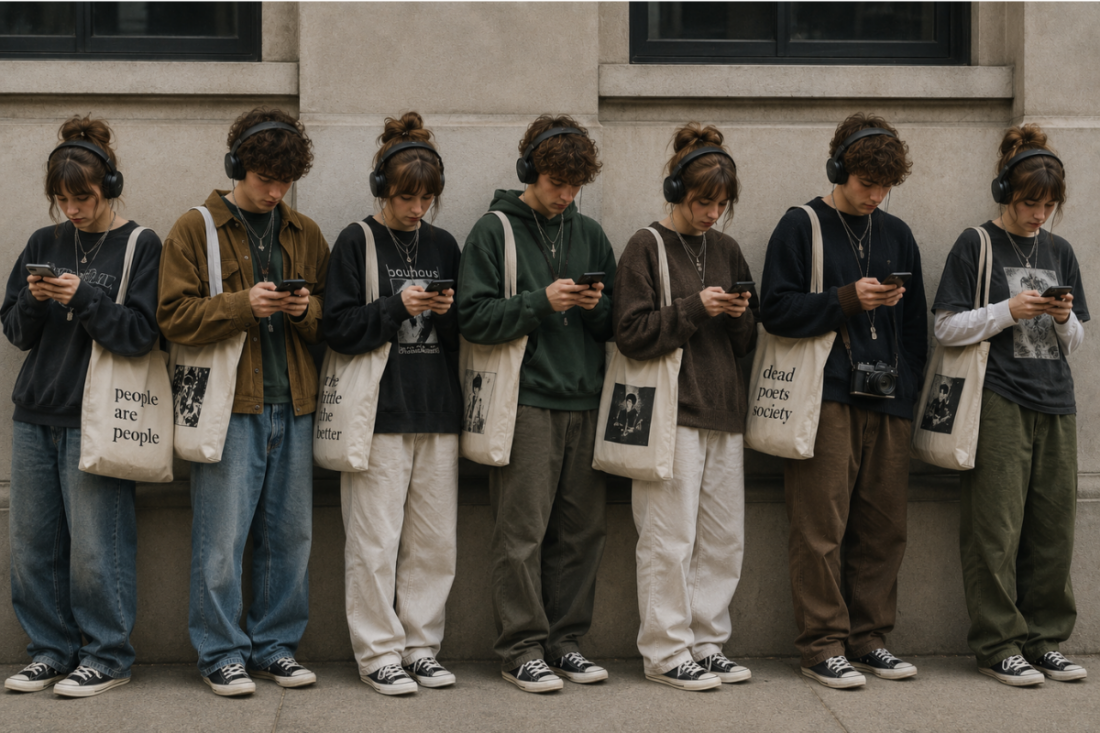
Everyone wants to be different until being different starts to look exactly the same.
Scroll any social media feed for more than a few minutes, and a pattern starts to emerge — not sameness exactly, but a curated kind of difference. Everyone is trying, very deliberately, not to look like everyone else. Yet, the end result often feels more uniform than distinct.
This is the paradox of performative individualism: in a culture that prizes uniqueness above all else, the act of appearing unique becomes standardized. Difference becomes aesthetic. Identity becomes something to be signalled, refined and displayed — less a private sense of self and more a public-facing project.
At its core, performative individualism isn’t about being different. It’s about being seen as different.
Traditionally, individuality has been understood as something that developed internally — shaped by personal experiences, beliefs and relationships. It was not necessarily visible, nor did it need to be validated by an audience. Today, however, individuality seems to be increasingly externalized. It exists in bios, posts, playlists, outfits and opinions, all of which are subject to public interpretation.
A simple example can be found in the way people present their interests online. Someone might describe themselves as having “niche taste” in music or film, carefully curating their selections to avoid anything too mainstream. However, scroll through enough profiles, and the same “niche” artists, the same underground films and the same carefully worded captions begin to repeat.
What is framed as obscure becomes widely recognizable. What is meant to distinguish starts to blend.
Another example is the way that we decide to clothe ourselves. One person decides to dress “differently” — thrifted layers, oversized silhouettes, deliberately clashing colours. It feels personal, expressive. But within months, the same look appears across campuses, Pinterest boards and TikTok tutorials. Suddenly, there are guides on how to achieve the “effortless unique” look.
Even personality can become aestheticized. Think of the “main character” energy trend, where people frame their lives as cinematic narratives, or the “nonchalant, detached” persona that signals emotional depth without vulnerability. These are presented as ways of standing out, yet they rely on shared scripts. To adopt them is, in many ways, to step into a role that others already recognize.
This is not accidental. Social media platforms reward visibility, and visibility requires legibility. To be recognized as “different,” users must rely on signals that others already understand. A certain style of humour, a particular aesthetic or even a recognizable tone — these become shorthand for individuality. However because they are recognizable, they’re also replicable.
From a sociological perspective, this reflects a collective shift from authenticity to performance. The self is no longer just something we are — it is something we do. We construct identities through repeated actions, posts and expressions, all of which contribute to a coherent public image. Over time, maintaining that image can become more important than the internal reality it is supposed to represent.
This is where the tension begins. If individuality is something performed, then it is also something that can be optimized. People learn what kinds of “unique” traits receive attention and validation, and they adjust accordingly. The result is a feedback loop: the more a certain form of individuality is rewarded, the more it is reproduced.
Consider the difference between liking something privately and liking something publicly. You might genuinely enjoy a random, slightly embarrassing playlist — songs you would never post because they do not fit your “taste,” or even promote ideas that you don’t personally align with, because they suit your “brand.”
Over time, these small decisions add up. The version of yourself that exists publicly becomes narrower, more refined and less representative of who you really are.
In a digital environment where personal branding is increasingly important, individuality becomes a form of capital. Being distinctive can translate into followers, opportunities and influence. As a result, people are incentivized to package their identities in ways that are both unique and marketable.
This can create a sense of distance between the public self and the private self. When so much energy is invested in maintaining a particular image, it becomes difficult to separate who you are from how you are perceived.
This raises an important question: what happens to authenticity in this environment?
Authenticity is often defined as being true to oneself, but that definition becomes complicated when the “self” is constantly being shaped by external feedback. If your sense of identity is influenced by what gains attention, approval or validation, then authenticity is no longer purely internal. It becomes relational — something negotiated between the individual and their audience.
One way to think about this is through risk. Genuine individuality often involves the possibility of being misunderstood, overlooked or even rejected. For example, posting something you genuinely care about — even if it is not trendy, polished or widely appealing — risks getting less engagement. Wearing something you actually like, rather than something that fits an aesthetic, risks standing out in a way that is not immediately validated.
Performative individualism, by contrast, minimizes that risk. It allows you to appear different while still operating within recognizable boundaries.
Encouraging authenticity, then, is not about rejecting all forms of presentation or curation. It is about being aware of when those choices are driven more by perception than by genuine preference. It is about allowing for moments that do not translate neatly into content.
This might look like sharing a song you love, even if it does not match your usual taste. It might mean admitting uncertainty instead of presenting a fully formed opinion. It might involve choosing not to post something at all — keeping parts of your life unobserved, unmeasured and unperformed.
At the same time, it is important not to force uniqueness where it does not naturally exist. Not every interest needs to be rare. Not every opinion needs to be unconventional. Sometimes, liking something popular is simply that — liking something popular. Trying too hard to be different can be just as performative as trying to fit in.
The challenge is that this approach does not always produce immediate rewards. It may not generate the same level of attention or validation. It may even feel uncomfortable in a space where visibility is constant and comparison is unavoidable.
But where does this leave the idea of individuality?
On one hand, the desire to stand out is not new. People have always sought ways to define themselves, to express their identities, to differentiate themselves from others. What has changed is the context in which this desire operates. In a highly visible, highly networked environment, individuality is no longer just personal — it is public, measurable and, to some extent, competitive.
On the other hand, the persistence of this paradox suggests that individuality cannot be fully reduced to performance. Even within systems that encourage conformity, people continue to search for ways to express something that feels real, something that is not entirely dictated by trends or expectations.
The question is not whether you are performing — to some extent, everyone is. The question is how much of that performance is chosen, and how much of it is automatic.
If standing out increasingly looks the same, what does it mean to actually be different? If authenticity involves risk, how much risk are we willing to take? In a world where identity is constantly on display, what parts of ourselves are we willing to keep — not hidden, but simply our own?

Leave a Reply