
THE UNIVERSITY OF SASKATCHEWAN’S MAIN CAMPUS IS SITUATED ON TREATY 6 TERRITORY AND THE HOMELAND OF THE MÉTIS.
THE UNIVERSITY OF SASKATCHEWAN’S MAIN CAMPUS IS SITUATED ON TREATY 6 TERRITORY AND THE HOMELAND OF THE MÉTIS.
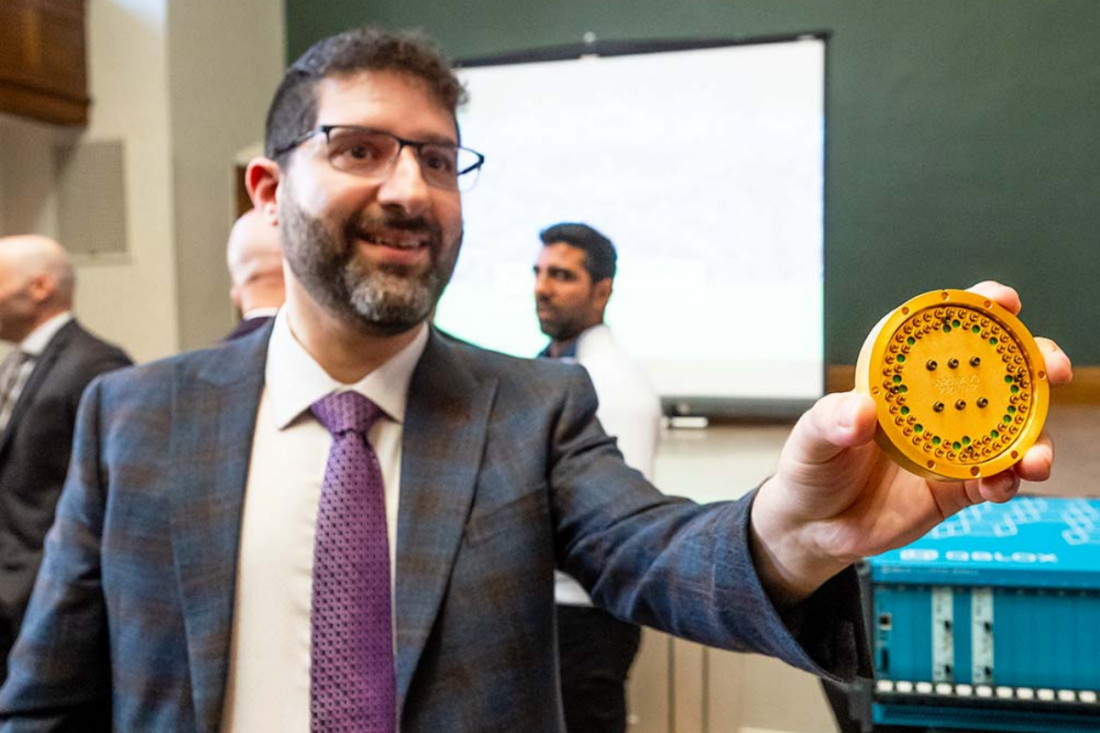
A conversation with Professor Steven Rayan on qubits, cutting-edge research and why USask is betting big on the future of computing
It’s not every day that a university announces it’s bringing one of the most advanced computing systems in the world onto campus, let alone one that operates colder than outer space. But that’s exactly what’s happening at USask, where a fully built quantum computer, the first of its kind to be added to a Canadian university campus, is set to redefine not only research but what students can access and experience during their degrees.
To understand what this means for students and for the future of technology, The Sheaf spoke with Steven Rayan, Director of the Centre for Quantum Topology and its Applications (quanTA) and Professor of Mathematics, who is helping lead the initiative.
As Rayan explains, “A quantum computer is a revolutionary type of computing device that uses quantum physics … to process information in powerful new ways.” Traditional computers rely on bits like the familiar 1s and 0s that represent “on” and “off”. However, complex problems can take enormous amounts of time and computational power because they must be processed step by step.
Quantum computers, however, change the rules.
Instead of bits, they use “qubits,” which behave less like simple switches and more like dimmers. “They can be 1 or 0 or anything in between,” Rayan explains. This “in between” state is known as superposition, meaning a quantum computer can explore many possible solutions at once instead of checking them one at a time. For certain types of problems, that difference is massive.
That power has real-world implications. “When we ask for something very complicated, such as modelling how a new drug might impact our immune system, these computations might cycle through many trillions of bits over a long period: it may be hours, days, or weeks before we get answers,” Rayan says. Problems that might take classical computers days, weeks, or even longer could potentially be solved much faster. “We’ll be able to solve problems more rapidly as a result, especially the most complicated ones that affect us globally,” he says, pointing to areas like climate management and advanced medical research.
While the quantum computer has the potential to revolutionize research at USask, it won’t just be reserved for tenured profs.
“Students will be able to learn the technological skills of tomorrow by interacting with a real-life quantum computer today,” Rayan says. That access is what makes this project stand out. While researchers around the world currently rely on remotely accessible quantum platforms, having a machine physically on campus opens up entirely new opportunities for hands-on learning.
Even more striking is how rare this is. Very few universities globally have their own quantum computer, and USask is positioning itself as a national leader. According to Rayan, it will be “the first in Canada to own and operate a vendor-supported, open architecture quantum computer at a university.”
That leadership isn’t just about prestige, it’s about shaping the future of research and innovation.
“The University of Saskatchewan aims to be a leader in quantum science and technology in the country,” he says. With initiatives like quanTA and a broader signature area of research in Quantum Innovation, the university has already been building momentum in this space. The addition of an on-campus quantum computer takes that work “to the next level — where we can start turning theory into deliverables that will make a real difference.”
So what does that actually look like in practice?
Right now, researchers at USask are already exploring how quantum computing can tackle complex, real-world challenges. “We are already pursuing research … in managing electrical grids in an optimal way or discovering new medical innovations such as vaccines,” Rayan explains. These are problems with enormous numbers of variables, exactly the kind quantum systems are designed to handle.
The difference is scale and speed. Having a local machine means those research efforts could accelerate significantly. Instead of relying on limited remote access, researchers and potentially students will be able to experiment more freely and frequently.
For students wondering if this technology is accessible to them, the answer is encouraging: yes, but with context. It’s not quite like booking a study room in the library. Access will likely be structured through courses, labs, and research programs where students can meaningfully engage with the system.
“The quantum computer will be free for use for students who are taking courses or participating in research projects that require it,” Rayan says.
Thanks to a $2.5 million investment from Prairies Economic Development Canada, Innovation Saskatchewan and VIDO, the university does not need to pass costs onto students. Instead, the focus can remain on education and research opportunities.
When asked by a student about potential applications, Rayan responded: “Anything is possible!”
“Complicated problems with many variables [are] what quantum computers were built for.” While that doesn’t mean every problem is instantly solvable, it does highlight the machine’s potential in fields like engineering, physics and beyond.
However, a machine this advanced doesn’t come without challenges, especially when it comes to actually housing it.
Unlike a regular computer, a quantum computer is an extremely sensitive instrument. Its qubits must be kept at incredibly low temperatures to function properly. In fact, the system operates below 10 millikelvin — colder than -273 Celsius, and even colder than the vacuum of space.
“If you find yourself near the quantum computer, please know that you are standing next to the coldest point in the universe!” Rayan says.
Because of these requirements, the exact location of the machine on campus is still being finalized. “There are many factors to consider, including ease of access, research alignment, the availability of suitable spaces … and finally, security,” he explains.
For now, the timeline is also still unfolding. Students eager to see the system in action won’t have to wait forever, though.
“Once the system is fully ready in late 2026 or very early 2027, we hope to have live demonstrations of how it works and what it is capable of,” Rayan says.
That means in the near future, students could witness firsthand how quantum computing operates, bridging the gap between abstract theory and tangible experience.

Leave a Reply