
THE UNIVERSITY OF SASKATCHEWAN’S MAIN CAMPUS IS SITUATED ON TREATY 6 TERRITORY AND THE HOMELAND OF THE MÉTIS.
THE UNIVERSITY OF SASKATCHEWAN’S MAIN CAMPUS IS SITUATED ON TREATY 6 TERRITORY AND THE HOMELAND OF THE MÉTIS.
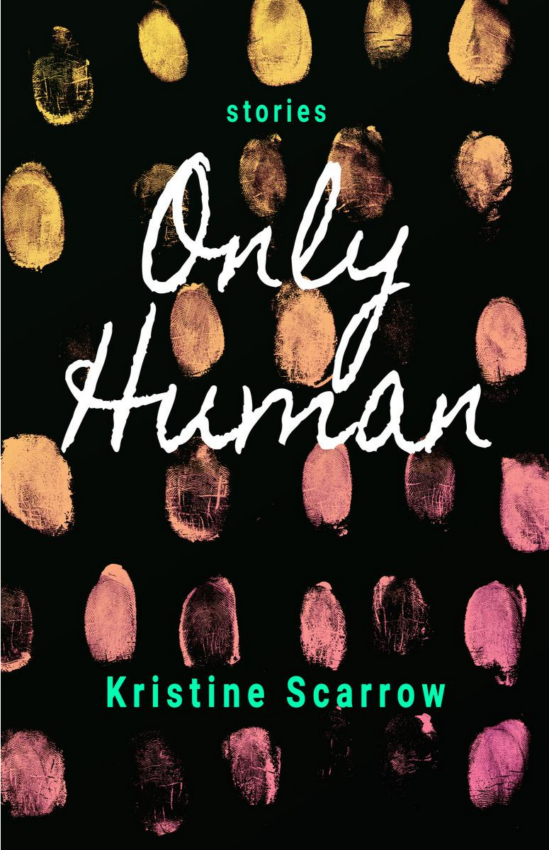
A closer look at the USask Alumni’s first collection of short stories
Kristine Scarrow’s newest book, Only Human, is all about the everyday moments that silently slip by us, only for you to discover their true magnitude long after they’ve passed.
The small conversation that veers in an entirely unexpected direction. The snap decision you make when your back’s against the wall, and it feels like time is slipping through your fingers like grains of sand. The dawning realization that comes just a little too late. Scarrow pulls these moments out of the background and asks us to really look at them, to sit with the choices and consequences that shape who we are.
Scarrow, who earned her Master of Fine Arts in Writing at the University of Saskatchewan in 2022, is a writer well known for her young adult novels. She’s built her career around telling the stories of characters trying to navigate their way through complicated and nuanced emotional terrain.
With Only Human, her fifth published work, she moves away from novels and into short fiction, bringing together 11 stories that focus on people under pressure and the difficult choices they make when things start to unravel.
The stories are all set across Saskatchewan, but the complex challenges and emotional turmoil the characters face are universal. Relationships reaching their breaking point. Facing illness or loss. Someone realizes they aren’t where they thought they’d be in life. While the settings are familiar enough to audience members from Saskatchewan, the experiences and how they’re dealt with are all part of the human experience — a testament to the collection’s title.
Across the collection, characters are pushed into situations where they have to make decisions they never would have expected to face. Some are impulsive. Others come after long, arduous periods of hesitation. What connects them all is the pressure behind the decision. Scarrow returns repeatedly to the idea that people don’t always act in predictable ways when circumstances become difficult. “We think that our oral codes might be black and white,” she says, “but I’m suggesting that it’s always a grey area.”
The beauty of Scarrow’s work comes from her interest in the moral dilemmas and the human condition. She asks not just what people would do in such situations, but why they would do it, and how those decisions would sit with them in the aftermath. As she explains, the idea that people operate with clear, fixed moral lines doesn’t always hold up in reality when circumstances become more difficult than what one thinks they can bear.
That perspective shapes how the stories unfold. Rather than offering clear judgments, the collection stays with the conditions that lead to each choice. In some cases, readers may find themselves surprised by what a character does. In others, the reaction may feel uncomfortably familiar.
Scarrow is less interested in whether a decision is right or wrong than in how it comes about. “You might see behaviour that shocks you,” she explains, but the goal is for readers to contemplate why this might have happened.”
Her interest in those questions is closely tied to her background. Scarrow studied psychology and sociology at the University of Saskatchewan during her undergraduate years, and later worked in social and healthcare settings. For five years, she served as a writer-in-residence at St. Paul’s Hospital, where she worked with patients and families, helping them write about their experiences.
That work changed how she understands storytelling. In the hospital, she met people at points of uncertainty and vulnerability, often when they were dealing with illness or loss. Writing offered a way to process those experiences. “People just want to be heard in life,” Scarrow says.
Many of the individuals she worked with did not initially see themselves as writers. Some hesitated to begin, unsure whether their stories were worth telling. “I have nothing interesting to say,” they would tell her. But once they started, that assumption often shifted. Scarrow describes hearing stories that were “wild and varied,” even when the person telling them saw their life as ordinary.
That belief carries into Only Human. The characters are not framed as exceptional, but their experiences are treated as meaningful. The collection gives space to the kinds of struggles that are often kept private, and it resists reducing them to simple explanations. Even when a character’s actions are difficult, the stories stay with the conditions that shaped them.
Scarrow hopes readers will approach those moments with a degree of openness. “Even if they don’t agree with what the character has done,” she says, the aim is to understand it.
The structure of the short story form plays a key role in how these ideas are presented. Compared to a novel, the space is more limited, which changes how scenes are built and how quickly events unfold.
“Everything’s much more tight-knit,” Scarrow explains, noting that there is less room to develop characters and situations over long stretches. Each story has to establish its world and reach its turning point within a smaller frame. In an era where attention spans are dwindling by the minute, I can’t help but compliment her on her impeccable timing.
That compression gives the stories a certain immediacy. Readers are brought into a situation quickly and asked to engage with it without the extended context a novel might provide. At the same time, the collection still aims to create a sense of depth. Scarrow points to the challenge of ensuring that readers leave each story with a clear understanding of who the characters are and what motivates them, even within those boundaries.
Endings reflect this approach as well. Many of the stories don’t offer a full resolution. Instead, they stop at a point where something has shifted, leaving the outcome open.
“There aren’t really any neat and tidy endings,” Scarrow says, describing that choice as intentional. The effect is that readers are left to consider what might follow, and how the characters might live with the consequences of what has happened.
At the same time, the collection builds a larger picture through its recurring themes. Questions about identity, responsibility and change appear in different forms across the stories. Many of the characters are dealing with the sense that their lives are not aligned with their expectations, and that addressing that gap may require difficult or uncomfortable action.
Scarrow did not initially plan the collection around a single idea. “I didn’t make a collection that necessarily did this,” she says, but as she continued writing, a pattern became clear. The idea of people facing moral uncertainty emerged as something of a thread connecting the stories together.
For readers, the effect is often one of recognition. Not in the exact details, but in the emotions behind them. Scarrow describes the book as speaking to “anybody in adulthood who has faced difficulties” or felt that life can become overwhelming. The situations may differ, but the underlying experiences are widely shared.
By the end of Only Human, the stories don’t resolve into a neat single message to take home. Instead, they leave behind a set of questions about how people respond under pressure and how those responses are shaped.
Scarrow returns to that uncertainty directly, noting that people may believe they know how they would act, “until we’re faced with that … we may surprise ourselves.”
Only Human also fits within a long tradition of Canadian short fiction, with Scarrow drawing inspiration from writers like Alice Munro and Mavis Gallant. Like those authors, Scarrow focuses on the internal lives of her characters and the significance of everyday moments. While the scale may be small, the emotional impact is not.
By the end of the collection, the stories don’t really point towards a single message or conclusion. What remains instead is a set of situations that invite reflection. How people respond under pressure. How decisions are made. The context in which you exist, and how they factor into how you respond to the world around you. How others might be understood, even when their actions are difficult to accept.
That question stays with the reader after the book is finished, not because it’s stated directly, but because it’s built into each story:
What would you do?
Leave a Reply