
THE UNIVERSITY OF SASKATCHEWAN’S MAIN CAMPUS IS SITUATED ON TREATY 6 TERRITORY AND THE HOMELAND OF THE MÉTIS.
THE UNIVERSITY OF SASKATCHEWAN’S MAIN CAMPUS IS SITUATED ON TREATY 6 TERRITORY AND THE HOMELAND OF THE MÉTIS.
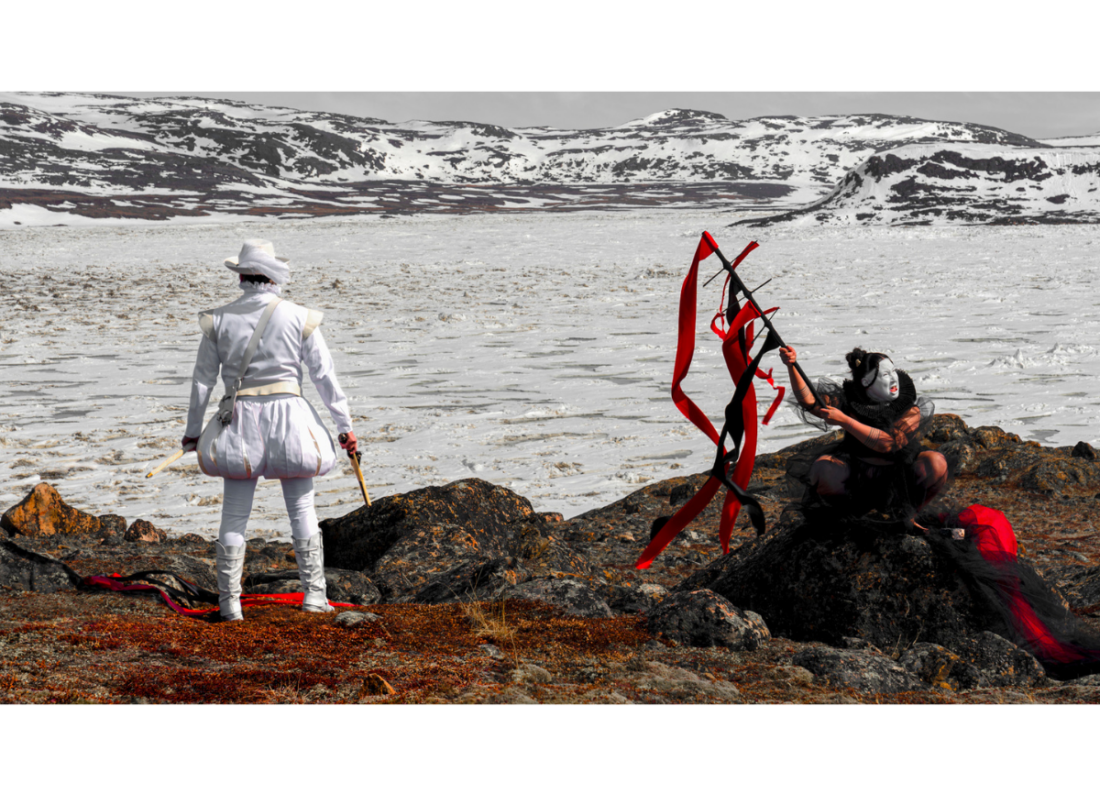
Sikuvoq, sikuerpoq / When the ice holds, when it breaks by Laakkuluk Williamson and Jamie Griffiths at Remai Modern
Sikuvoq, sikuerpoq / When the ice holds, when it breaks at Remai Modern brings together performance, video installation and works from the museum’s Inuit art collection in a way that doesn’t fit into a single interpretive framework.
Presented as part of the multi-year project Carried by rivers, held by lands, the exhibition focuses on movement across land, across histories and across ways of knowing, rather than fixed narratives or conclusions.
The exhibition centres on the collaborative practice of Laakkuluk Williamson and Jamie Griffiths. Williamson, a Kalaaleq (Greenlandic Inuk) artist who grew up in Saskatoon and is now based in Iqaluit, works across performance, writing and curatorial practice. Her work is grounded in uaajeerneq, or Greenlandic mask dancing, an improvised and often confrontational performance form that engages themes of sexuality, fear, humour and the limits of human knowledge. She has received significant national recognition, including the prestigious Sobey Art Award in 2021.
Griffiths, originally from the United Kingdom, has worked extensively in Canada and Nunavut, developing a multidisciplinary practice that includes film, photography and digital media. His work frequently addresses identity, colonialism and displacement. His ongoing collaboration with Williamson, which began in 2016, forms the basis of several key works in the exhibition.
One of the central installations, “Silaup Putunga” (“the hole in the universe”), is a large-scale, double-sided video work rooted in uaajeerneq. The installation disrupts a fixed viewing position, requiring movement around and between screens. Instead of presenting a linear narrative that tells the audience exactly what the artists are trying to convey, it produces overlapping visual and sensory experiences that hold multiple states simultaneously — ordinary and extraordinary, familiar and unfamiliar, allowing for audience interpretation based on their own perceptions of the experience.
The work emphasizes perception as contingent and relational, shaped by position and duration rather than stable observation.
In dialogue with this installation are selected drawings, prints and paintings by Inuit artists from Remai Modern’s collection. These works depict hunting scenes, encounters with animals and representations of supernatural beings. Within the context of the exhibition, they operate less as documentary or illustrative images and more as sites of transition, where boundaries between human and non-human, physical and spiritual are not fixed. The placement of these works alongside “Silaup Putunga” reinforces the idea of images as thresholds rather than endpoints.
The exhibition also engages explicitly with colonial histories through collaborative works such as “White Liar” and “The Known Shore: Frobisher and the Queen”. These pieces address the processes of naming, mapping and claiming associated with European exploration, with particular reference to Martin Frobisher. The shoreline acts as a key conceptual site for the work — a point at which land is rendered “known” through acts of designation and possession. By situating the viewer in relation to this space, the artworks highlight the ongoing implications of these historical frameworks.
Rather than isolating colonial history as a past event, the exhibition positions it as an active structure that continues to shape contemporary relationships to land and knowledge. Viewers are implicated within these systems, not positioned outside them.
This approach aligns with the broader aims of Carried by rivers, held by lands, which situates the museum within a network of ecological and cultural relations extending beyond its physical location along the South Saskatchewan River.
Curated by Aileen Burns, Johan Lundh, Tarah Hogue and Maria Lind, the project brings together artists working across the northern hemisphere, from urban centres to remote and rural communities. It foregrounds land- and water-based knowledge systems while addressing the ongoing impacts of colonialism and the climate crisis. Rather than functioning as a conventional group exhibition, it emphasizes connection, continuity and the development of relationships over time.
Within this framework, Sikuvoq, sikuerpoq operates through a series of shifts — between immersion and distance, between narrative and sensation. The title itself, referencing the cyclical formation and breaking of sea ice, provides a conceptual structure for understanding these transitions. Ice becomes a metaphor for instability and change, but also for the conditions under which movement and connection are possible.
The exhibition does not provide a singular interpretive pathway. Instead, it requires sustained attention and a willingness to engage with uncertainty. Meaning is not presented as fixed or self-contained but emerges through interaction — between works, between viewers and between different systems of knowledge.
Williamson’s connection to the city also adds an additional layer of continuity between the local context and broader circumpolar perspectives. The exhibition works to expand the scope of what is considered local, and positions the museum as part of a larger network shaped by rivers, land and ongoing movement.
Sikuvoq, sikuerpoq / When the ice holds, when it breaks offers an approach to exhibition-making that prioritizes relationality over resolution. It does not seek to simplify complex histories or reconcile competing perspectives into a unified narrative. Instead, it maintains space for multiplicity, where different realities can exist simultaneously without being reduced to a single point of view.
The exhibit will be available for viewing at the Remai Art Gallery until July 13.
Leave a Reply