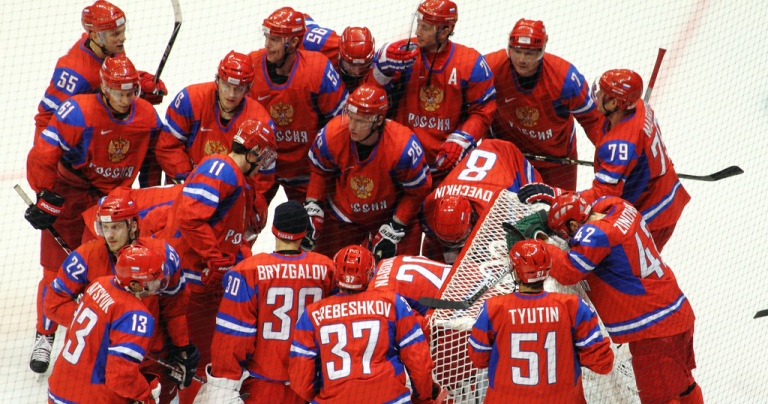
Russia’s underachievement in men’s Olympic Hockey
Is the fall of the USSR to blame for Russia's disappointing performance in Vancouver?
The dissolution of the Soviet Union marked an ideological revolution for many people living in Russia — specifically, the shift from government and militaristic control to individual rights and freedoms marked a new age of individuality for the Russian people.
In the world of Soviet hockey, however, the effect of individuality has been less positive — at least in terms of winning at ice hockey. And to be blunt, Russia has lacked the same dominance the Soviets once had before the collapse of the USSR.
The Soviet hockey team was first allowed to enter the Winter Olympics in 1956 — the first Winter Olympics in the post-Stalinist period — and competed until the Soviet Union’s collapse in 1991. Between those years, the Soviets won gold in seven of the nine tournaments and, in 1992, the Unified Team, consisting of members from most former Soviet countries, won gold.
Essentially, teams consisting of players from the Soviet Union won gold in eight of the 10 tournaments and the Soviet Union planted itself as arguably the most dominant team in Olympic Men’s hockey history — the only team that might compete for this title is the Canadians, who won gold six of seven times from 1920 to 1952.
Since countries of the former Soviet Union started competing as separate countries in Olympic hockey, there have been five Winter Olympics. Russia has only medalled twice — silver in 1998 in Nagano and bronze in 2002 in Salt Lake City. Compared to the Soviet Union’s success, this should be considered a failure on the Russians’ part and Prime Minister Vladimir Putin has already scorned the Russian team’s 2010 performance.
The fact that Russia is a smaller region than the Soviet Union and that international hockey competitions aren’t always consistent in terms of the quality of players (some years have lacked NHL-quality players), it is possible that there is a correlation between Russia’s lack of success in Olympic hockey and these factors.
However, in spite of these issues, Russia has always been regarded as boasting some of the most talented players in the world and it is a wonder as to why the Russians cannot succeed.
With individualism being a relatively new political concept for Russians the country has been breeding talented superstars, but has ignored the aspect of team that the Soviets once had.
Before the Soviet Union dissolved, the country was, of course, communist.
This meant that the region of Russia was devoted to its state and not its individuals. For the Soviet hockey team, this meant that international competitions were a stage to display their country’s dominance and not a stage to display individual talent.
Nationalistic pride and government pressure existed behind every game and the nation — much like in Canada, today — would feel a sense of rise or fall, depending on the team’s success. Thus, the team was placed above the individual.
In fact, in his biography, the Soviet coach from 1946-1975, Anatoli Tarasov, is said to have adopted a coaching style that was “non-individualistic,” “patriotic,” and team-oriented.
Prior to the break-up of the Soviet Union, in order for Soviet-born players to play in the NHL they had to sneak away from their home teams without warning. One of the most famous examples of this is Sergei Fedorov, who, while his team from Moscow was in Seattle for an international competition, snuck out of his hotel room and boarded a plane to Detroit to play for the Red Wings who had taken the risk and drafted the Soviet player.
However, after the dissolution of the Soviet Union the NHL became a realistic and attainable goal for many Russian players — Russia’s hockey mentality switched from a nationalistic mentality to one of individual success and freedom.
In terms of this individual freedom and the development of talented individuals, Russia has been extremely successful. They have developed such great players as Igor Larionov, Pavel Bure, Sergei Gonchar, Ilya Kovalchuk, Pavel Datsyuk, Evgeni Malkin and Alexander Ovechkin.
The interesting thing about talented Russian players, however, is that a majority of them are forwards. It is this offensively minded mentality that perfectly exemplifies the state of Russian hockey today — the concept of individuality in Russia emphasizes individual success over team success and leads to the production of a lot of amazing forwards; unfortunately, it leaves Russia lacking in terms of defense and defensive play.
Not to say that Russians do not take pride in their hockey, but there is a clear distinction between the playing-styles of Russians and Canadians — who are very nationalistic when it comes to hockey.
When Canada played Russia in the 2010 Games’ quarter-final, the distinctions between Canada’s team-style game and Russia’s individual-style game was most apparent. Canadian players passed quickly, shot when they had their chances, cycled the puck around the outside boards and worked together to knock the Russians off the puck.
Needless to say, the Canadians played solid defensive hockey; the Russians, on the other hand, held on to the puck too long, cherry-picked at the opposing teams’ blue-line in order to get breakaways and had defencemen who were too slow to stop Canada’s speed. It was this dissociation between defence and offence that was Russia’s greatest downfall — the offensive players refused to adequately help out their struggling defense and, consequentially, the lack of defensive skill prevented Russia from getting the puck onto their offensive players’ sticks. Along with this, each player held onto the puck too long and it led to turnovers in both their offensive and defensive zones.
Russia’s attempt to develop individual scorers and the greatest hockey players in the world has been a relative success, but, unfortunately, they have ignored the aspects of team play.
However, this appears to be changing.
Players such as Alexander Ovechkin are re-establishing a sense of national pride in Russian hockey — Ovechkin intends to play for Russia in the 2014 Olympics even if it means illegally breaking from his NHL contract — and with the next Olympics being in Russia, it is likely that Russian nationalism will be stronger than ever.
If the Ice Hockey Federation of Russia takes this year’s surprising underachievement in the Olympics as a sign, they will rethink their development strategy. If they can focus on developing stronger defencemen and a more team-style game, the Russian team, fuelled by a sense of revamped nationalism, will be a difficult team to play in the 2014 Olympics.
- -
photo: Flickr


Great article. This absolutely hits the nail on the head of why Russian hockey has been inferior to Soviet hockey. They have no defensive concept and were beaten to so many pucks in the game against Canada. They have great individual players but no system like the Soviets.
The lack of success in sports in general for russia is in my view something to do with to do with Russia’s economy in general and the inability to successfully cheat with drugs unlike the past.
Due to modern strict doping testing Russians cannot cheat and hence cannot as many medals. Added to it the emergence of Asian countries like China, korea japan who have systematically taken over winning in all the sports that the russians were good at.
Now it takes grassroots performance in an individualistic society. With the closed society Russia can safely kiss goodbye of having ever dominating sports again. They are at the best a middle sports power.
does it not occur to people that the soviets won those gold medals against college kids, part-time mechanics, and faded ex-pros? the canadians could not send their top team to the olympics for decades thanks to IIHF politics and thanks to the NHL – and the russians/soviets took full advantage. This does not mean that the canadians would have been dominant – far from it, I think – but at least a few of those olympic gold medals would have gone to canada instead of to the Soviet Union. thus, you must ask yourself how truly legitimate was the Soviet dominance – and whether their relative ineffectiveness in the past 20 years is simply the inevitable outcome of now having to complete on the same level playing field as everyone else?
Thanks for the comments, guys.
Blaine, I vaguely touch on this issue in the article: “The fact that Russia is a smaller region than the Soviet Union and that international hockey competitions weren’t always consistent in terms of the quality of players (some years have lacked NHL-quality players), it is possible that there is a correlation between Russia’s lack of success in Olympic hockey and these factors.”
I agree that this might have had a lot to do with it, but for the sake of the article I chose not to focus too much on it in order to focus on ideological changes. It’s just a theory and if someone wants to dispose of it as “bullshit,” so be it. It’s their call.
Of course, I am way too young to have been able to truly analyze the Soviet games in terms of team play, but I did some research on the Soviet coach from 1946-1975, Anatoli Tarasov, in order to figure out the Soviet’s strategies. Unfortunately, I could only find information from Wikipedia, but it had this to say:
“When hockey was introduced in the USSR, Tarasov, like the rest of the nation, fell in love with the game. It was his ideals and philosophies that shaped the Russian game into what it is today- fast, graceful, non-individualistic, and patriotic. To him, real teamwork was based on a common aim- comradeship and caring for each team member. This is why he introduced a rule that in order to make the line-up the team had to approve of each player”
I just thought that this was very convenient considering the article
Oh, and this too: “Anatoli devised many new training techniques. Most of them centered on passing, for he felt passing was the key to their success, ‘after all, the ultimate aim of a pass was to get a free player. So if our opponents make 150 passes in a game against our 270, this means we had 120 more playing opportunities’”
Kevin Menz, Thanks for adequately
arcticle. I was seriosly surprise, watching the “game of year” (3:30 AM in Moscow). O my God – it is my team? Where is violent struggle? Not burn with the desire to play! I dont know what the matter with us. A sin and a shame before canadians. I know you wait this game with interests, too. We have a grudge against players – no team, no play, no life-and-death struggle! I don’t believe it! Score is not important, defeat is not important. Desire of win victory – its important. Big-headedness may be? I hope Russia & Canada not to take long to appear a interesting hockey nations “confrontation” in game… like ‘72.
“We want” only Canada now. From Russia with best regard.
Hey Alexey,
Thanks for reading and for the comment! It’s truly appreciated. It’s great that we can get a perspective from someone living in Russia and I think I agree with your terms, “Big-headedness” and “no team…”
Thanks again,
Kevin
I, too, can’t wait for the next game.
Kev
Holy heck, an intriguing idea to say the least, and while I do not simply dismiss the notion as ‘bullshit’ I would be interested in getting your opinion on a couple of points you bring up in the article. You mention that the success of the USSR was connected to the unity and patriotic efforts. I would contend that this reduced Russian success is not necessarily induced as a result of increased individualism producing a decrease in national pride but rather the manifestation of global parity in the sport and a decrease in team experience (which stems from increased individual opportunities).
The notion of reduced Russian pride is something I would contend has not happened and that the Russian population retains a strong connection not only to the current nation but the history of the USSR as well. The fall of communism served to remove a single minded focus for the members of the hockey team who where free to pursue individual goals, such as play in the NHL, as you mention in your article. Observing the accomplishments of The People’s Republic of China at the past several Olympic games serves as a strong template for comparison. Previously an after thought in many sporting events the desire of the government to produce a competitive state has generated incredible results. Would you say this is the result of a greater sense of national pride displayed by its athletes or the fact these athletes are commissioned to focus on a single goal, I don’t have a tremendous amount of research on the subject but I do believe potential training for children begins at very young ages away from home, something not often occurring in the Western world. In communist states sporting events provide a venue for the ruling body to display the strength of its populous to the world and have always served as a political tool.
The list of Russian players you provide are some of the best players on the planet and not all for their offensive gumption, Pavel Datsyuk is arguably the best 2-way-forward in the game today.So while I would agree with you in the fact increased opportunities has limited the amount of time these player train and play together, unlike the era of soviet dominance, I would attribute the quarter final beating to a poor game and a goaltending performance that can only be described as Tommy Salo-esque (reference to the Belarus defeat of Sweeden in 2002).
Hey Scotty, holy heck to you as well! Thanks for the in-depth commentary.
Perhaps I should have been more careful in my word choices, because I can see how some inconsistencies could be read into it. However, when I say, “Russia’s hockey mentality switched from a nationalistic mentality to one of individual success and freedom,” I am referring to the idea that “nationalism” or “devotion-to-country” (which might have been the better term) was less forced upon them and they could focus on pursuing individual goals. The ability to pursue individual goals, of course, would likely increase Russian nationalism – because they would take pride in this new sense of independency. So, I can see how the argument might cycle.
When I refer to a “revamped sense of nationalism” at the end, I am trying to imply that the idea of individual success will no longer take priority over the more holistic team success. But yes, I do agree that Russians have always taken pride in their hockey – as seen with Alexey’s comment. However, I feel that recently that sense of pride has translated itself into individual efforts as opposed to team efforts.
Hope this clears things up.
I agree that Datsyuk is one of the best two-way players and it appeared that he was given the role of playing a lot of defence in that game. However, there were some instances when I had him in mind holding onto the puck too long. I recall one where he got knocked off the puck in his own zone in what should have been a routine chip up the boards. Perhaps he put too much pressure on himself as an individual, which led to those little mistakes – the classic, “he tried to do too much” thing. I just felt they could have played a better team-game and that individual egos prevented them from doing this – so I thought I might try and explore where the individuality in their hockey style came from.
And yes, goaltending sucked, but I still think Canada would have won that game easily, regardless.