
THE UNIVERSITY OF SASKATCHEWAN’S MAIN CAMPUS IS SITUATED ON TREATY 6 TERRITORY AND THE HOMELAND OF THE MÉTIS.
THE UNIVERSITY OF SASKATCHEWAN’S MAIN CAMPUS IS SITUATED ON TREATY 6 TERRITORY AND THE HOMELAND OF THE MÉTIS.
LISA JOHNSON
Special to the Sheaf
Â
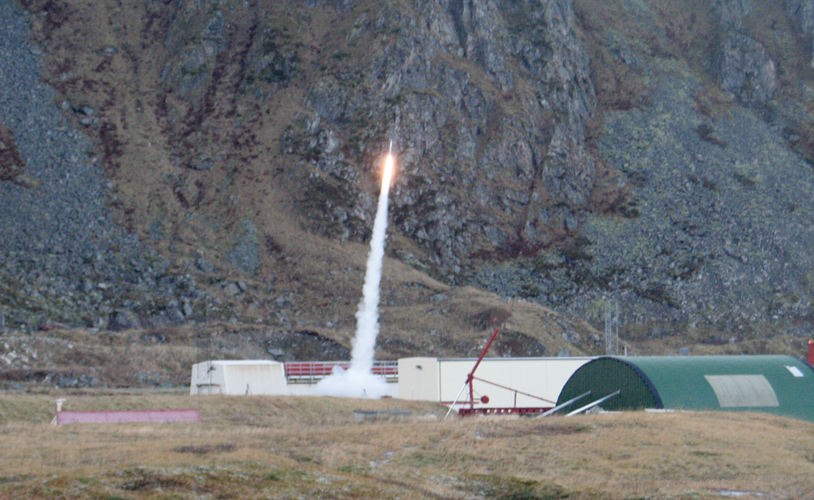
If it weren’t for the rocky, Mars-like arctic landscape in the background, you might mistake video of an experimental rocket being launched at the Andøya Rocket Range in Norway for footage of a spacecraft blasting out of Cape Canaveral.
For the two University of Saskatchewan engineering and physics students who earlier in November travelled to a northern island in Norway to help launch the rocket, it was just as exciting.
“Watching that rocket disappear into the sky made all of our efforts, travelling and lack of sleep really pay off,” recalls Ashton Reimer.
Reimer and Robyn Reist were selected as two of only four Canadian students (out of about 50 applicants) selected to go to Norway for an intensive week-long course that culminated in the building and launching of a special “sounding rocket.” Sounding rockets are launched to take measurements and perform scientific experiments during sub-orbital flight.
The rocket launched this month, the CaNoRock 1, was assembled from the propulsion system of an old missile donated by a military company. It was outfitted with sensors to measure magnetic fields, temperature, pressure and acceleration.
Climbing 9.4 kilometres into the air, the rocket sped up to a supersonic Mach 4 — four times faster than the speed of sound — before it fell into the Norwegian Sea.
“To keep it from blowing up when it came back down, we had to give it a parachute,” said Reimer.
Reist says the launch happened so fast that she felt a delayed sense of accomplishment.
“Now that I think of it, knowing that a circuit that I put together was a part of that rocket — it feels pretty awesome,” she said.
The two U of S students were registered in a class offered by the University of Oslo and their registration, travel and accommodation were funded by the Norwegian Ministry of Education and Research, the Canadian Space Agency and the U of S President’s office.Â
Reist and Reimer could not have launched a sounding rocket in Canada since there are no longer any rocket ranges. The main focus of CaNoRock, an exchange program between Norway and Canada, is to give students exposure to space research and the space industry. Cheaper than launching an orbital satellite, sounding rockets are ideal for training students.
“Everything they’ve been learning about physics and engineering came into play — they needed to know their stuff to be a part of this project,” said the students’ supervisor Kathryn McWilliams.
“There is an astonishing amount of physics that goes into these things,” added Reimer.
The two not only learned about how sounding rockets work, but also their various uses. The Andøya Rocket Range is actually part of a hub of facilities specializing in space and atmospheric studies such as the ALOMAR Observatory, a lab that looks at atmospheric phenomena such as the aurora borealis (also known as the northern lights).
As the polar region undergoes ever-increasing economic expansion, projects like these help meet the huge demand for research on the climate, weather and environment of the north. The aurora borealis, for example, interfere with GPS navigation in the arctic.
The trip gave Reimer and Reist the opportunity to meet like-minded people and share ideas. They spent the week attending physics lectures, learning about instrument assembly and taking tours together with students from all over the world.
They were also able to appreciate Norwegian culture first hand.
“I didn’t feel a huge culture shock,” Reist recalled, “until it came to breakfast. We ate sardines with tomato spreads.”
Reimer also took the opportunity to take a quick dip in the frigid arctic water off the Norwegian Coast.
Watch the video of the launch at the U of S physics website.
 Â Â
 Â
Lisa Johnson is a graduate student in English interning with U of S Research Communications. – – photo: Robyn Reist

Leave a Reply