
THE UNIVERSITY OF SASKATCHEWAN’S MAIN CAMPUS IS SITUATED ON TREATY 6 TERRITORY AND THE HOMELAND OF THE MÉTIS.
THE UNIVERSITY OF SASKATCHEWAN’S MAIN CAMPUS IS SITUATED ON TREATY 6 TERRITORY AND THE HOMELAND OF THE MÉTIS.
GREG REESE
Arts Editor

John Shelling became the managing editor for Blackflash Magazine in August 2008. His own work has been shown at Saskatoon’s Paved Art gallery in the form of a minimalist video installation that involved projecting images of the viewers back into the gallery — showcasing bodies and spatial relations in the gallery.
Shelling spoke with the Sheaf about the Cuban-born American artist Felix Gonzalez-Torres and the powerful effects of his interactive installation-pieces.
The Sheaf: When did you first encounter Felix Gonzalez-Torres?
John Shelling: Probably around 2000 when I first went to art school. My sister went to Minnesota and saw a piece. Gonzalez-Torres prints out posters and the viewers can take them home; my sister brought one back and had it on her wall for a number of years, so that is where I first heard of him.
Sheaf: Is it reasonable to call his work minimalist?
Shelling: Yeah, I think so.
He has so many different kinds of work, billboards and installation stuff and, yeah, I guess it is minimalist.
He does a type of minimalist sculpture — he puts posters in the gallery, they are stacked and they look like minimalist sculpture.
Sheaf: What are the strengths in this minimalist approach?
Shelling: The way he uses it.
The strength is that there is not that much to take in so you really have to deal with the work. There isn’t a lot of fluff.
The strength is that there is not that much to take in so you really have to deal with the work. There isn’t a lot of fluff.
-John Shelling
A lot of his stuff, you really have to interact with it. For instance, he puts out candy. He’ll have enough candy in the gallery so that it has the same weight as his recently deceased lover. Viewers take a candy with them. There isn’t anything but candy. And if he had added anything else it would have taken away from the piece.
Sheaf: What are your favourite works?
Shelling: I really like the posters because I like the idea of giving away the art for free. But I also like the candy piece. I saw that when I went to Japan.
It was sort of a devotional thing; it was based on his love for this man that he cared for so much. You end up taking the piece of candy and putting it in your mouth, so it’s a different experience because another sense is involved not usually present in art. He has done a whole bunch of different ones with the idea of candy and posters.
He set up these photograph-posters — and he can keep showing these things forever. I mean, you can still experience that piece of candy, all you need is the same candy and the same amount and put it in any space — same with the posters.
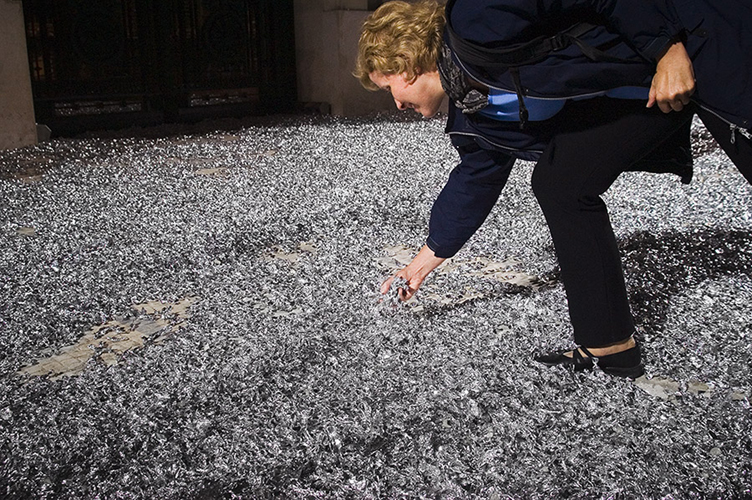
Anyone can experience that. You don’t have to be rich to get this work.
For example, the poster that my sister brought back; I didn’t see the installed piece but I got to experience the idea — even though Japan was the only time I saw his work in a gallery.
Sheaf: How has his work affected you?
Shelling: It’s had a thoughtful effect.
It makes me more thoughtful of the viewing experience: of how people go into a gallery, what is going on internally for them and what is important for me to give to them or for them to take away from it. Gonzales-Torres makes that literal. I mean, what a viewer takes away from the gallery in his case is literal, which I find very interesting.
It has made me think about how the viewer would interact with the art pieces as well as the gallery space, so that has been a really big influence.
Sheaf: There are major funding changes concerning smaller Canadian magazines presently in the works. Will these changes affect Blackflash magazine?
Shelling: Yes they will. We need to get about 700 new subscribers by May in order to retain that funding. I’m not sure if it will happen right now; it has been going slow but we are looking into new ways of doing that. I think we should be able to do it within two years but we need all the help we can get.
– –
photos: John Shelling / François Bouchet

Leave a Reply