
Campus group works to ban bottled water
Resource abuse and waste are among main concerns
TANNARA YELLAND
Associate News Editor
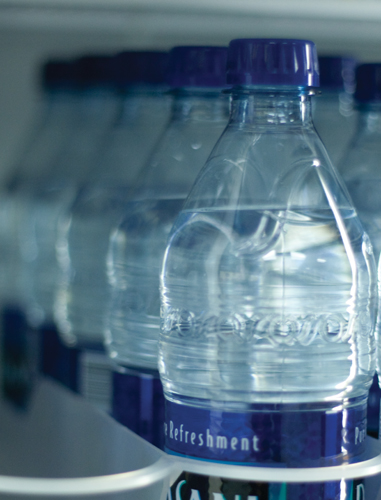
A new student group is attempting to stop the sale of bottled water on campus.
Students recently started a Facebook group called “Ban Bottled Water on U of Sask Campus” that is devoted to publicizing and garnering support for this cause.
The group’s Facebook page includes the waste inherent in the sale of single-use plastic bottles and the fact that the bottles leech chemicals into the surrounding environment once disposed of among their reasons for seeking to ban the bottles.
The group has already attracted criticism for its use of computers, which require energy and thus make use of fossil fuels. But organizer Shannon Dyck feels it is important to work for change despite such inconsistencies.
“No matter what we do we will have an impact on the Earth…. People who choose to support environmental and human rights campaigns shouldn’t be seen as people who neglect to see the hypocrisy in the things they do and support. We see the hypocrisy; we’re just trying to make positive change where we can.”
Other resistance has come from people who see the group’s efforts as an infringement on their right to choose to buy water. Dyck acknowledges the importance of freedom of choice and says rather than angrily confront people about their choice to buy bottled water she might ask them why they made that choice.
“Once people understand the impacts of this industry,” she said, “many get on board and support the campaign.”
Many students on campus already agree with the movement. As of Oct. 12 the Facebook group has 105 members.
Water can be acquired from the water fountain for free and old water bottles can simply be re-used.
But Dyck cautions that people should not be re-using plastic bottles that were intended for single use.
“Bottled water bottles are not meant to be reused – neither are any other single use plastic bottles. That’s what re-usable water bottles are for.”
The group is circulating a petition around the U of S campus. The petition has 10 main points and draws evidence for its case from work done by the Polaris Institute, the Canada Bottled Water Association and the Chartered Institution of Water and Environment Management.
“Bottled water results in resource use and waste production that could otherwise be avoided,” reads the petition. And according to the CBWA, the production of one litre of bottled water requires 1.3 litres of water.
Water is often taken from sources in areas like India that are already short on clean, drinkable water to be packaged for sale in, for example, Canada, where there is no shortage of clean tap water. The petition cites the Polaris Institute saying the bottled water industry “threatens to cause a divide between those who can and can not pay for bottled water.” If bottled water becomes the primary way of distributing water this has clear implications for future generations of impoverished citizens.
The Ban Bottled Water group will have a booth in the Arts Tunnel during Green Yourself Week, Oct. 19 to 23. When the petition has accumulated enough signatures the group will present it to both the University of Saskatchewan Students’ Union and the Graduate Students’ Association in the hope that the associations will help the group in its cause.
- -
photo Robby Davis


I think Shannon Dyck and her group are wasting their time and wasting more resources by trying to ban the safest and healthiest food a human can consume.
Take a look at everything else that you can buy from the supermarkets, tuna, meats, vegetables, fruits, alcohol, computers, TVs, clothes, cars, everything is imported and uses way more resource to produce than water.
This group is simply showing their ignorance and their inability to be thinkers and leaders, they are simply following certain groups and voices.
Finally with bottled water, people get a choice to drink a healthier water than tap water with all its toxicity and what is happening, every man and his dog wants to find a reason to fight or ban it.
Bottled water has the smallest carbon footprint of any bottled beverage, whether measured by water usage, plastics/oil deployment or greenhouse gases emitted. And, according to the provincial stewards responsible, 60 per cent of plastic beverage containers, including bottled water, were diverted from landfill across Canada last year.
You are right it takes 1.3Lt of water to produce 1 Lt of bottled water, but did you know that it takes over 14 Lts of water to produce 1 Lt of Coke Cola/Pepsi, etc.
Wouldn’t it make more sense to put your energy and efforts into banning these drinks which are not only using way more resources but are also extremely bad for our health.
Bottled water represents only 0.04% of sales in all bottled beverages, so if we ban cola drinks, imaging the water and resources we would save then, it’s really simple, then Dyck can drink bottled water without guilt.
Signed by
A thinker and leader not a follower.
Our campaign is: “Students FOR better access to clean, free drinking water on the U of S Campus. Students AGAINST the provision and sale of bottled water on the U of S campus.” We’re not out to “ban the safest and healthiest” thing a human can consume; we’re actually trying to make it more accessible and free. The purchasing of bottled water by the public is a fairly recent thing, so it’s important to nip this in the bud now before we end up getting ourselves even further into the problem of water privatization.
I’m glad you brought up the issue of Coke though… You seem very passionate about banning Coke and Pepsi, that’s great! There is a group of students that has been working solely on this issue. I can put you in touch if you’d like? Or maybe you would like to start a campaign of your own?
It’s crucial that thinkers and leaders (such as yourself) support important causes. This may mean that thinkers and leaders act as followers as well, but following someone else’s lead isn’t such a bad thing when it’s a good idea that’s being followed. It’s unfortunate that some of the most worthwhile (and most needed) environmental actions aren’t happening quickly (or at all) because they aren’t backed strongly enough by the public – leaders, thinkers, followers and the like. Issues have to become popular first before people start thinking about them and subsequently start doing something about them… which usually means the smallest things that are the least difficult to get done, get done first :( So, let’s get support to reduce bottled water usage today and maybe tomorrow, once people understand more about water issues, they’ll support tackling the problem of Coke and Pepsi. From there, maybe they’ll start thinking more about what they buy and how much they buy. From there, maybe they’ll be more open to learn about how their actions are related to things like climate change, biodiversity loss, resource use and extraction, pollution, poor agricultural and manufacturing practices, social justice and human rights abuses, etc. My point is: one thing at a time, no effort isn’t a wasted effort, and the community needs leaders, thinkers AND followers.
I think some of the comments you raised are important, but I would disagree that bottled water is superior to tap water here in Saskatoon. According to Health Canada, tap water is just as safe as bottled water. In fact, many times bottled water IS tap water – sometimes further treated, sometimes not. Of course, there are examples of unsafe drinking water in Canada and the outcomes of that can be devastating, but bottled water can also pose health risks, as well as environmental risks. Plus, a municipal water treatment plant is likely going to be more accountable to you and I than a private bottled water company.
P.S. If you’re going to comment on an individual’s or group of individuals’ inabilities and ignorance, I would suggest you actually talk to them first. You’re making assumptions and being presumptuous.